


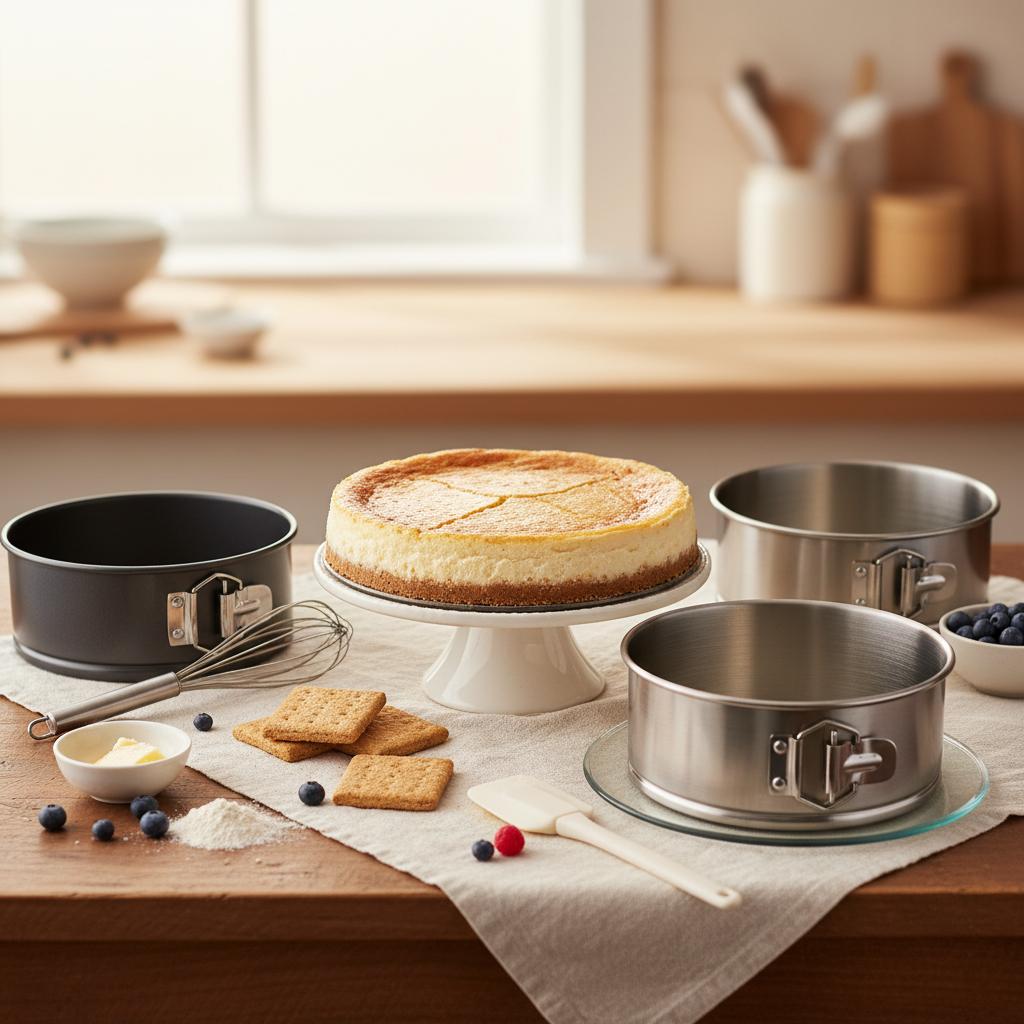
Du hast ein Rezept für eine 20-cm-Springform, aber nur 18, 24 oder 26 cm zu Hause? Mit einer einfachen Formel kannst du die Zutatenmenge schnell an deine Backform anpassen.
Converting cake tin sizes made easy – so every recipe fits your tin
You’ve found a recipe that sounds perfect – but unfortunately it’s meant for a 20 cm springform tin and at home you only have 18, 24 or 26 cm?
That’s not a problem. You don’t need to buy a new tin or give up on the recipe. With a simple conversion, you can adapt the quantity of ingredients to the tin you have quite quickly.
Why the size of the tin makes such a difference
At first glance, the difference between a 20 cm and a 24 cm tin doesn’t seem that big. Nevertheless, a 24 cm tin needs considerably more batter.
The reason: it’s not just the diameter that gets bigger, but the entire area of the tin.
So if you simply put the same amount of batter into a larger tin, your cake will usually turn out much flatter. In a smaller tin, on the other hand, it will be taller and often needs longer in the oven.
The simple formula
For round cake tins, you can remember this formula:
new diameter² ÷ old diameter²
The result is your conversion factor.
An example:
Your recipe is meant for 20 cm tins, but you want to use a 24 cm tin instead.
24² ÷ 20² = 1,44
So you need roughly 1.44 times the quantity of ingredients.
For example, 200 g of flour becomes about 288 g.
Quick guide for a 20 cm recipe
If your recipe was originally meant for a 20 cm springform tin, you can use these values as a rough guide:
| Tin size | Quantity of ingredients |
|---|---|
| 18 cm | approx. 0.8 times |
| 20 cm | 1.0 times |
| 24 cm | approx. 1.4 times |
| 26 cm | approx. 1.7 times |
You don’t have to calculate every gram to the decimal point. For most cakes, you can round the quantities sensibly.
And what do I do with eggs?
With flour, sugar or butter, the calculation is straightforward. With eggs, it gets a little trickier.
If, for example, the calculation gives you 2.8 eggs as the result, you can usually simply round up to 3 eggs for a normal sponge cake.
For more delicate recipes, such as sponge, you can also whisk an egg and weigh out the amount you need.
Do I need to change the baking time too?
Unfortunately, this can’t be converted quite as precisely.
If you adjust the quantity of ingredients to suit the tin and the cake stays roughly the same height as a result, the baking time can stay similar. Still, it’s worth checking a little earlier.
The skewer test is often more helpful here than the exact number of minutes in the recipe.
What happens if I don’t convert anything at all?
That works too, of course – but the result will change.
In a larger tin, your cake will be flatter and probably done sooner. In a smaller tin, it will be taller, take longer and in the worst case may even overflow.
So if you don’t mind the height of the cake, you don’t necessarily have to convert. But if you want a result similar to the original recipe, it’s definitely worth it.
The short version to remember
For a recipe for a 20 cm tin:
18 cm → × 0.8
20 cm → × 1
24 cm → × 1.4
26 cm → × 1.7
This lets you adapt many recipes quite easily to the tins you already have at home.
Leave a Reply